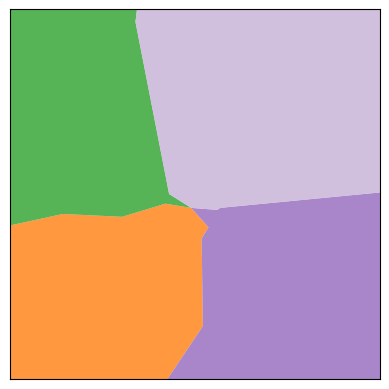
Example
First, we’ll use shapely and geopandas to create a GeoDataFrame of “toy precincts” from scratch.
import random
import geopandas
import maup
from shapely.geometry import Polygon

random.seed(2023) # For reproducibility

ppolys = []
for i in range(4):
    for j in range(4):
        poly = Polygon(
            [(0.5*i + 0.1*k, 0.5*j + (random.random() - 0.5)/12) for k in range(6)] +
            [(0.5*(i+1) + (random.random() - 0.5)/12, 0.5*j + 0.1*k) for k in range(1,6)] +
            [(0.5*(i+1) - 0.1*k, 0.5*(j+1) + (random.random() - 0.5)/12) for k in range(1,6)] +
            [(0.5*i + (random.random() - 0.5)/12, 0.5*(j+1) - 0.1*k) for k in range(1,5)]
        )
        ppolys.append(poly)

toy_precincts_df = geopandas.GeoDataFrame(geometry = geopandas.GeoSeries(ppolys))
toy_precincts_df.plot(cmap = "tab20", alpha=0.7)
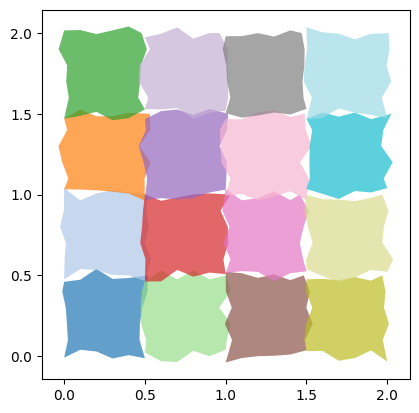
Check for gaps and overlaps:
>>> maup.doctor(old_precincts)
There are 28 overlaps.
There are 23 holes.
False
All the gaps between geometries in this example are below the default
threshold, so a basic application of smart_repair will resolve all
overlaps and fill all gaps:
toy_precincts_repaired_df = maup.smart_repair(toy_precincts_df)
toy_precincts_repaired_df.plot(cmap = "tab20", alpha=0.7)
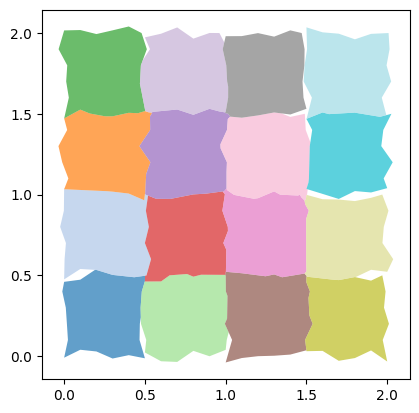
We can check that the repair succeeded:
>>> maup.doctor(old_precincts)
True
Now suppose that the precincts are intended to nest cleanly into the following “toy counties:”
cpoly1 = Polygon([(0,0), (1,0), (1,1), (0,1)])
cpoly2 = Polygon([(1,0), (2,0), (2,1), (1,1)])
cpoly3 = Polygon([(0,1), (1,1), (1,2), (0,2)])
cpoly4 = Polygon([(1,1), (2,1), (2,2), (1,2)])

toy_counties_df = geopandas.GeoDataFrame(geometry = geopandas.GeoSeries([cpoly1, cpoly2, cpoly3, cpoly4]))

toy_counties_df.plot(cmap='tab20')
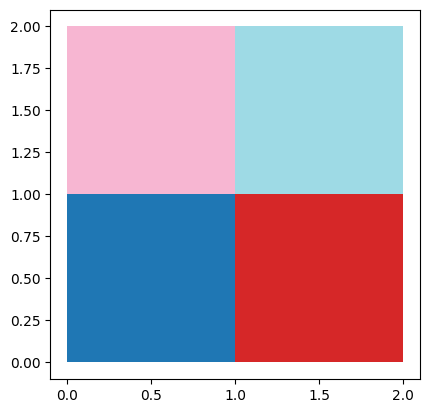
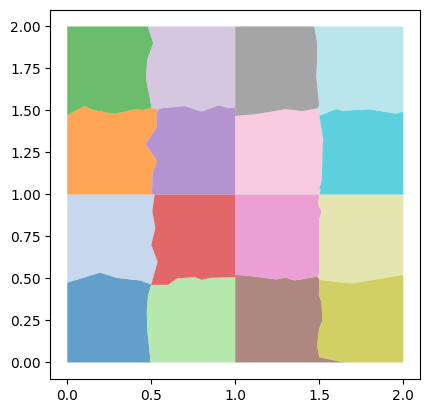
We can perform a “county-aware” repair as follows:
toy_precincts_repaired_county_aware_df = maup.smart_repair(toy_precincts_df, nest_within_regions = toy_counties_df)
toy_precincts_repaired_county_aware_df.plot(cmap = "tab20", alpha=0.7)
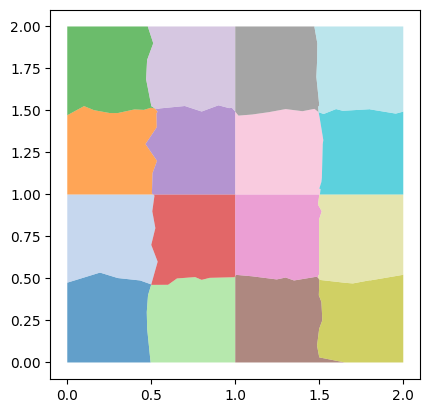
Next, suppose that we’d like to get rid of small rook adjacencies at corner points where 4 precincts meet. We might reasonably estimate that these all have length less than \(0.1\), so we can accomplish this as follows:
toy_precincts_repaired_county_aware_rook_to_queen_df = maup.smart_repair(toy_precincts_df, nest_within_regions = toy_counties_df, min_rook_length = 0.1)
toy_precincts_repaired_county_aware_rook_to_queen_df.plot(cmap = "tab20", alpha=0.7)
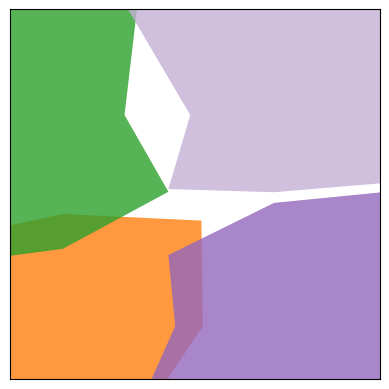
The difference is hard to see, so let’s zoom in on gap between the 4 original precincts in the upper left-hand corner.
Original precincts:
County-aware repair:
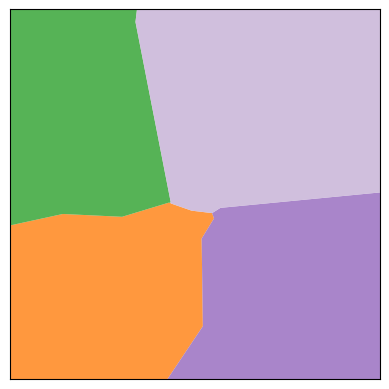
County-aware repair with rook adjacency converted to queen: